

VR Training Design
-
This project explored VR as a scalable way to deliver consistent technical training while reducing the cost and logistics of traditional in-person sessions. After COVID-era budget pressures, the business needed a solution that maintained training quality while lowering travel expenses for technicians attending training centers.
My role was to lead the learning design for the VR experience. I defined the instructional approach, course structure, content flow, and overall learning architecture, then partnered with a vendor who built the application based on those designs for a VR headset platform.
-
Instructional Design
Testing
Script Writing
Collaborate
Create a Video Tutorial
-
Wind Industry Technicians
-
Oculus Rift, PowerPoint, Microsoft Word, Adobe Acrobat, Photoshop

-
Visited the Denmark Training Center with vendors for direct engagement with the Crane.
Experienced the existing course as potential technicians, understanding material for VR transition.
Noted crucial details like hydraulic delays for authenticity.
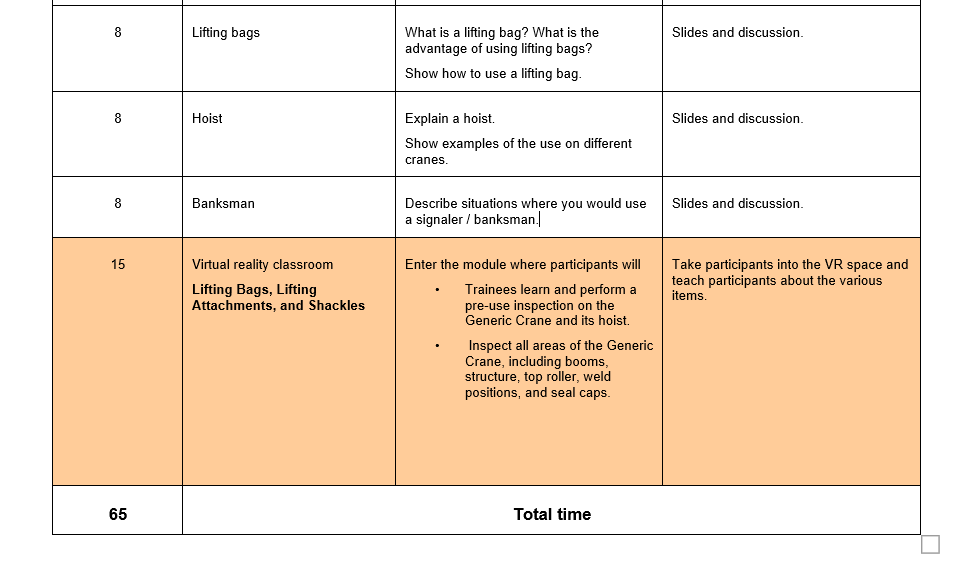
Updated the Educational Instructional (EI) with VR-specific insights and coordinated a review with vendors.
-
Reviewed the updated EI and identified which requirements translated directly to VR versus those needing adaptation.
Proposed VR-ready alternatives for practical components and documented open questions for SME confirmation.
Defined the target learner flow and key interactions to guide the vendor build and reduce rework.
Aligned with stakeholders on next steps, decisions, and the review plan to move into development.

-
Used an iterative, Agile approach to handle evolving requirements and reduce rework.
Tested beta builds throughout development and documented issues, usability friction, and content gaps.
Incorporated SME feedback and internal evaluations to refine the EI and improve accuracy and learner flow.
Finalized a polished release after multiple iteration cycles and stakeholder sign-off.
Created a short onboarding tutorial to help first-time VR users navigate the experience smoothly.

-
Deployed globally and supported localization, with translations produced in multiple languages including Chinese, Spanish, Danish, Hindi, Portuguese, and German.
Received positive feedback from experienced crane users on the realism and training relevance of the VR crane environment.
During evaluation, technicians trained in VR demonstrated strong performance against the same practical expectations used in traditional sessions.
Reduced travel-related training costs by enabling more training to occur without requiring technicians to attend a training center.
The success of this release led to discussions about expanding VR adaptations to additional training areas.